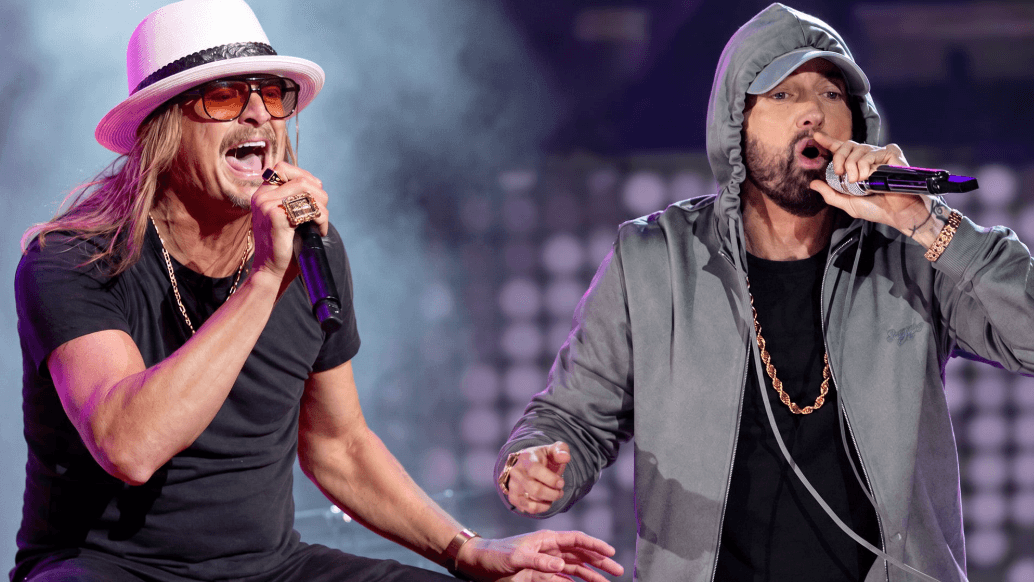
Kid Rock has revealed that artificial intelligence played a role in the creation of his recent collaboration with Eminem, adding another layer of conversation around the song “Heal My Faith.”
During an appearance on HBO’s Real Time with Bill Maher, Kid Rock explained that the gospel-style choir heard on the track was generated using AI rather than recorded by a traditional group of background singers. The song appears on his latest album, Halfway 2 Jesus, which was released on October 17.
Kid Rock said he recorded the song’s hook and harmonies himself but wanted a larger Southern gospel choir sound behind the record. His usual background singers were unavailable at the time, and rather than waiting for them to return, he decided to experiment with artificial intelligence.
According to Rock, he entered harmony and lead-note instructions into an AI system and asked it to generate a Southern gospel choir sound. He said he went through several versions before finding something that matched what he had imagined for the record.
The decision, he explained, was primarily about saving time rather than avoiding the cost of hiring singers. Rock described himself as impatient and said he increasingly thinks about how much time different creative processes require.
His comments quickly turned into a larger debate with Bill Maher over how AI could affect working musicians.
Maher questioned whether using artificial intelligence instead of hiring a choir effectively removed paid opportunities from real singers. Kid Rock pushed back by comparing AI-assisted production to earlier technological changes in music, including the introduction of drum machines.
At the same time, Rock acknowledged that artificial intelligence presents challenges that are different from previous recording technology. He said he views AI as another creative tool for now, but also expressed concern about its long-term impact and said he believes it should eventually face significant regulation.
“Heal My Faith” was not the only song on Halfway 2 Jesus to feature a large choir-style arrangement.
For “7 Sins,” which features Lil Wayne, Kid Rock took a more traditional approach. He used three actual backing vocalists and layered multiple takes of their performances to create the sound of a larger choir. That contrast shows that AI was not used in exactly the same way across the entire album.
Kid Rock had also discussed his use of AI before his appearance on Real Time. In an earlier Billboard interview, he revealed that he used the AI platform Suno during the making of Halfway 2 Jesus, primarily to help build choir arrangements and some orchestral elements. He emphasized that he was using the technology to help realize musical ideas rather than having AI write entire songs for him.
The revelation arrives while the music industry continues debating how artificial intelligence should be used in recording, songwriting and production.
Artists and producers are increasingly experimenting with AI for tasks including vocal processing, instrumental generation, demos and arrangement ideas. At the same time, musicians, labels and rights holders have raised concerns about copyright, unauthorized voice cloning and whether AI-generated music could replace paid creative work.
Kid Rock’s admission gives that debate another high-profile example involving two major artists.
The collaboration itself had already generated attention before the AI revelation because of the long-standing friendship between Kid Rock and Eminem.
Both artists emerged from Michigan’s music scene decades ago and have known each other since before Eminem became a global superstar. Eminem previously appeared on Kid Rock’s 1998 song “F* Off,”** while Kid Rock later appeared in the video for Eminem’s 2013 single “Berzerk.”
Their latest collaboration also attracted discussion because the two artists have publicly expressed different political views.
Kid Rock has been a prominent supporter of President Donald Trump, while Eminem has publicly criticized Trump and previously supported Democratic candidates. Some fans questioned Eminem’s decision to collaborate with Rock because of those differences.
Eminem responded to that criticism by emphasizing that the collaboration was about friendship rather than politics. He said working with Kid Rock was not about choosing political sides but about making music with someone he has known for years.
Kid Rock expressed a similar idea while discussing the collaboration. He said he hopes their ability to remain friends despite political disagreements can serve as an example for people who have allowed politics to damage relationships with friends or family.
Musically, “Heal My Faith” reflects the Christian and gospel influences that run throughout Halfway 2 Jesus. The album represents a noticeably different direction for Kid Rock, blending his established rock, country and hip-hop influences with more faith-centered themes.
The use of AI-generated choir vocals adds a technological element to that approach while highlighting one of the biggest questions currently facing the music business: how much of the creative process should artists hand over to artificial intelligence?
For Kid Rock, the answer appears to be that AI can be useful when treated as another production tool rather than as a complete replacement for human creativity.
His comments also make clear that he recognizes the potential risks. While defending his decision to use AI on “Heal My Faith,” he acknowledged that the technology could have broader consequences and argued that regulation will likely become necessary as the technology develops.
The debate surrounding the track therefore extends beyond Kid Rock and Eminem themselves.
With AI-generated vocals, instruments and even entire songs becoming easier to produce, artists are increasingly being forced to decide where they personally draw the line between technology assisting creativity and technology replacing musicians.
For “Heal My Faith,” Kid Rock chose AI to create the choir he wanted without waiting for human singers to become available.
Whether listeners view that choice as creative efficiency or another warning sign about AI’s growing role in music, the collaboration has now become part of a much larger conversation about the future of recording.